California Prop 1 Treatment Expansion: What It Means Now
California Prop 1 Treatment Expansion: What It Means Now If you follow California mental health and addiction policy, you have probably heard the latest claim…
California Prop 1 Treatment Expansion: What It Means Now
If you follow California mental health and addiction policy, you have probably heard the latest claim that California Prop 1 treatment expansion is ahead of schedule. That matters because big ballot measures often promise faster care, more beds, and better access, then get stuck in local delays, staffing gaps, or budget fights. This time, the state says the early numbers are moving in the right direction, with new capacity and treatment investments aimed at millions of Californians. But does that mean help will actually get easier to find in your county? That is the real test. Look, press releases love victory laps. Families, clinicians, and people trying to get into care need something more useful. They need to know what Prop 1 is funding, where the pressure points still sit, and what to watch next.
What stands out so far
- California says Prop 1 is beating early rollout goals for treatment and behavioral health capacity.
- The focus is on mental health and substance use treatment, including more places for people to get care.
- The big question is not the headline number. It is whether counties can turn funding into staffed, open treatment slots.
- Local execution will decide whether the California Prop 1 treatment expansion feels real to patients and families.
What is the California Prop 1 treatment expansion?
Prop 1 is California’s effort to shift more money and attention toward behavioral health treatment infrastructure, with a strong focus on mental health and substance use disorder care. In plain terms, the state is trying to add capacity. More beds, more treatment settings, more places for people with serious needs to go.
That sounds obvious. It is also badly needed. California has long had a mismatch between need and access, especially for people who need structured care, crisis stabilization, residential treatment, or ongoing support after a psychiatric or substance use emergency.
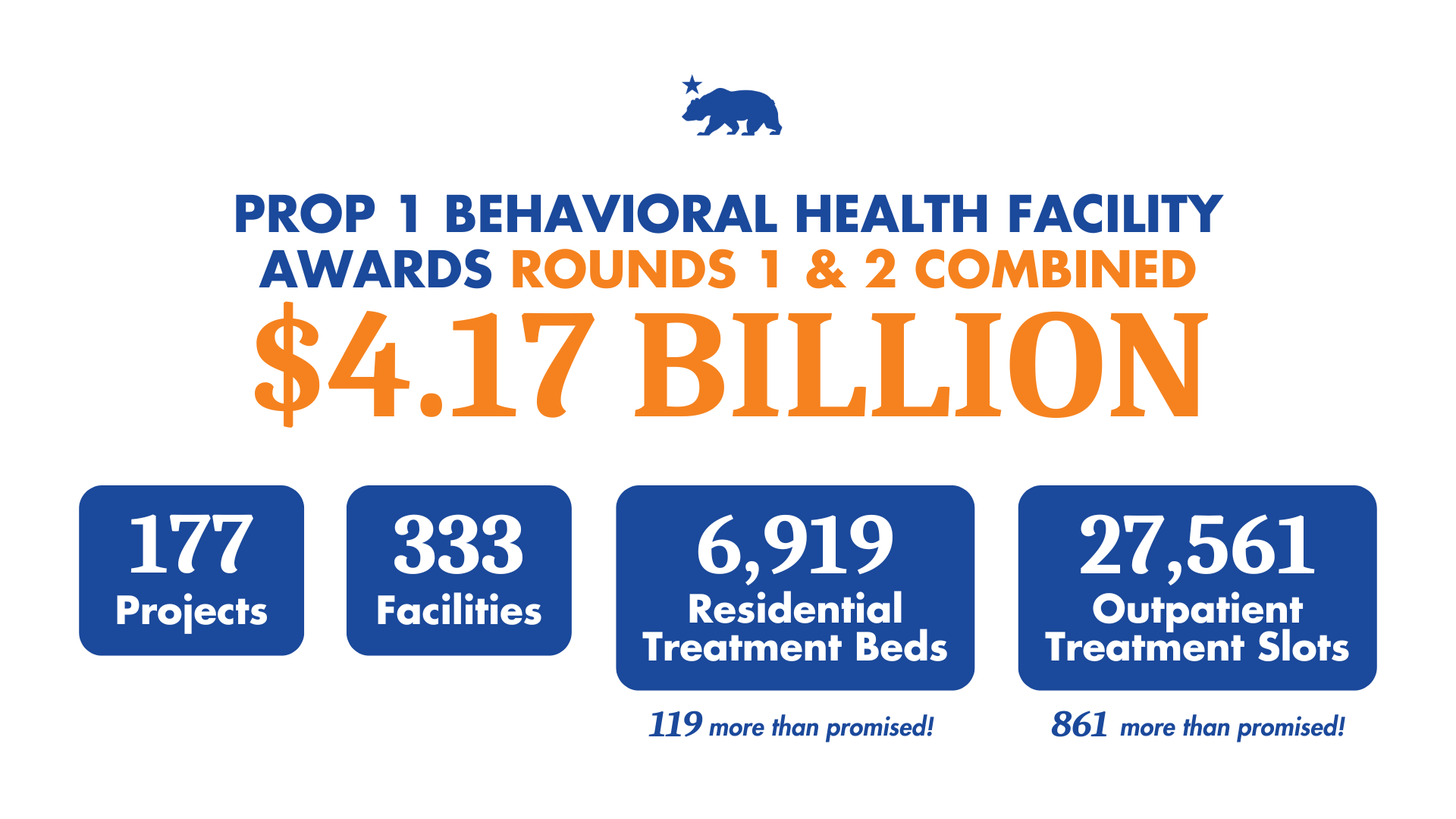
State leaders say Prop 1 is already exceeding goals and expanding treatment capacity statewide, with benefits expected to reach roughly 5 million Californians.
Here is the catch. Funding capacity on paper is one thing. Building sites, hiring clinicians, securing county partnerships, and opening doors to patients is another.
Why California Prop 1 treatment expansion matters for addiction and mental health care
If you have ever tried to find a treatment bed on short notice, you know how thin the system can feel. A county may have a crisis line and a referral network, but actual placement options can still be scarce, especially for people with co-occurring mental illness and substance use disorder.
That is where this measure could matter. If the California Prop 1 treatment expansion adds real, staffed treatment capacity, it can ease one of the most stubborn failures in the system. People often get assessed, stabilized for a moment, then bounced back out because there is nowhere appropriate to send them. It is like drawing up blueprints for a hospital kitchen while patients are still waiting for dinner.
Capacity is the non-negotiable piece. Without it, every other promise in the care pipeline gets weaker.
What the state says is happening now
According to Governor Newsom’s office, the rollout is ahead of schedule and exceeding early goals tied to expanding behavioral health treatment statewide. The administration frames this as proof that the state can move faster than critics expected.
Honestly, that is notable if it holds. California is not famous for friction-free implementation.
The announcement points to broader access and added treatment infrastructure, with the state arguing that millions of residents stand to benefit. It also fits Newsom’s larger push to show visible progress on homelessness, serious mental illness, and substance use treatment, all issues that have become politically loaded and operationally messy.
This is where healthy skepticism helps. Faster-than-expected commitments do not always equal faster admissions for patients. Counties and providers still have to translate state momentum into actual services.
Where the rollout could still get stuck
Anyone who has covered California health systems for a while has seen this pattern. Money lands. Local agencies announce projects. Then the slowdown begins.
- Workforce shortages. New beds mean little if psychiatrists, nurses, therapists, and support staff are hard to hire.
- County variation. Some counties move fast. Others struggle with planning, contracting, or facility development.
- Licensing and construction delays. Health infrastructure rarely opens as fast as politicians want.
- Continuity of care gaps. A person may enter treatment, then hit another wall when they need housing support, outpatient follow-up, or medication management.
And one more problem deserves attention.
Metrics can flatter a rollout before patients feel much difference.
A state can count planned units, approved funds, or projects in progress. Those are useful signals. But families want a simpler metric. Can my son, partner, or parent get in today?
How to read the numbers without getting fooled
What should you look for if you want the real story behind the California Prop 1 treatment expansion? Start with service availability, not just budget totals. Then look for county-level detail.
Ask these practical questions
- How many treatment slots are open now, not just planned?
- What level of care is being added, crisis, inpatient, residential, outpatient, or step-down support?
- Are substance use treatment services expanding alongside mental health care?
- Which counties are seeing the fastest gains?
- How long are wait times for placement?
- Are programs staffed well enough to operate at full capacity?
But there is another layer here. People with serious behavioral health needs often move through several systems at once, including hospitals, county behavioral health departments, housing programs, Medi-Cal managed care, and sometimes the courts. If those handoffs stay clumsy, added treatment capacity will still leak value.
What this means for families, providers, and people seeking care
For families, this news is encouraging, but it is not a reason to assume access problems are solved. If you are trying to help someone enter treatment, keep pushing for specifics. Ask about placement options, wait lists, insurance pathways, and whether the county has new Prop 1-backed programs coming online.
For providers, more state investment could create room to expand services, especially in counties where demand has outrun infrastructure for years. That said, providers will need staffing pipelines, contract clarity, and operational support, not just ribbon cuttings.
For people seeking care, the best near-term effect may be gradual. More treatment settings can improve the odds of finding an appropriate level of care, especially for people who need more than a brief crisis intervention. Slow progress is still progress, assuming it reaches the front door.
What to watch next in California Prop 1 treatment expansion
The next phase matters more than the headline. Watch for county-by-county reporting, timelines for opening treatment sites, and evidence that capacity is helping people with serious mental illness and substance use disorders move into sustained care.
Here is what I would watch most closely:
- Open and staffed treatment beds, not projected capacity
- Shorter emergency department boarding for psychiatric patients
- Faster placement into residential addiction treatment
- Better follow-up after crisis care
- Clear public reporting that separates promises from operating programs
And yes, politics will hover over all of it. Newsom wants proof that California can build a more functional treatment system. Critics want proof that this is more than a polished announcement. Who is right? We should know soon enough, because treatment access is one policy area where reality shows up fast.
The test is local
State leaders can claim momentum, and the early signs from Prop 1 may be solid. But behavioral health policy does not succeed in Sacramento press events. It succeeds when a person in crisis can get evaluated, placed, treated, and connected to follow-up care without hitting five dead ends first.
That is the standard worth using. If the California Prop 1 treatment expansion starts producing that kind of on-the-ground change across counties, this will be a real shift. If not, the state will need more than upbeat numbers to make its case.
This article is for educational purposes only and should not be considered medical advice. Always consult a qualified healthcare provider before making decisions about addiction treatment. If you or someone you know is in crisis, call SAMHSA's National Helpline: 1-800-662-4357 (free, confidential, 24/7).